A season of anticipation. One championship night.
Clash Royale is a mobile strategy game where players battle to take down their opponent’s towers. I brought that world to life for its World Finals, a live championship with fans in the venue and watching online.

- Creative & visual direction
- Set design
- Wayfinding & signage design
- Operations manual planning & design
- Event experience
Bring the game off the phone and into the room.
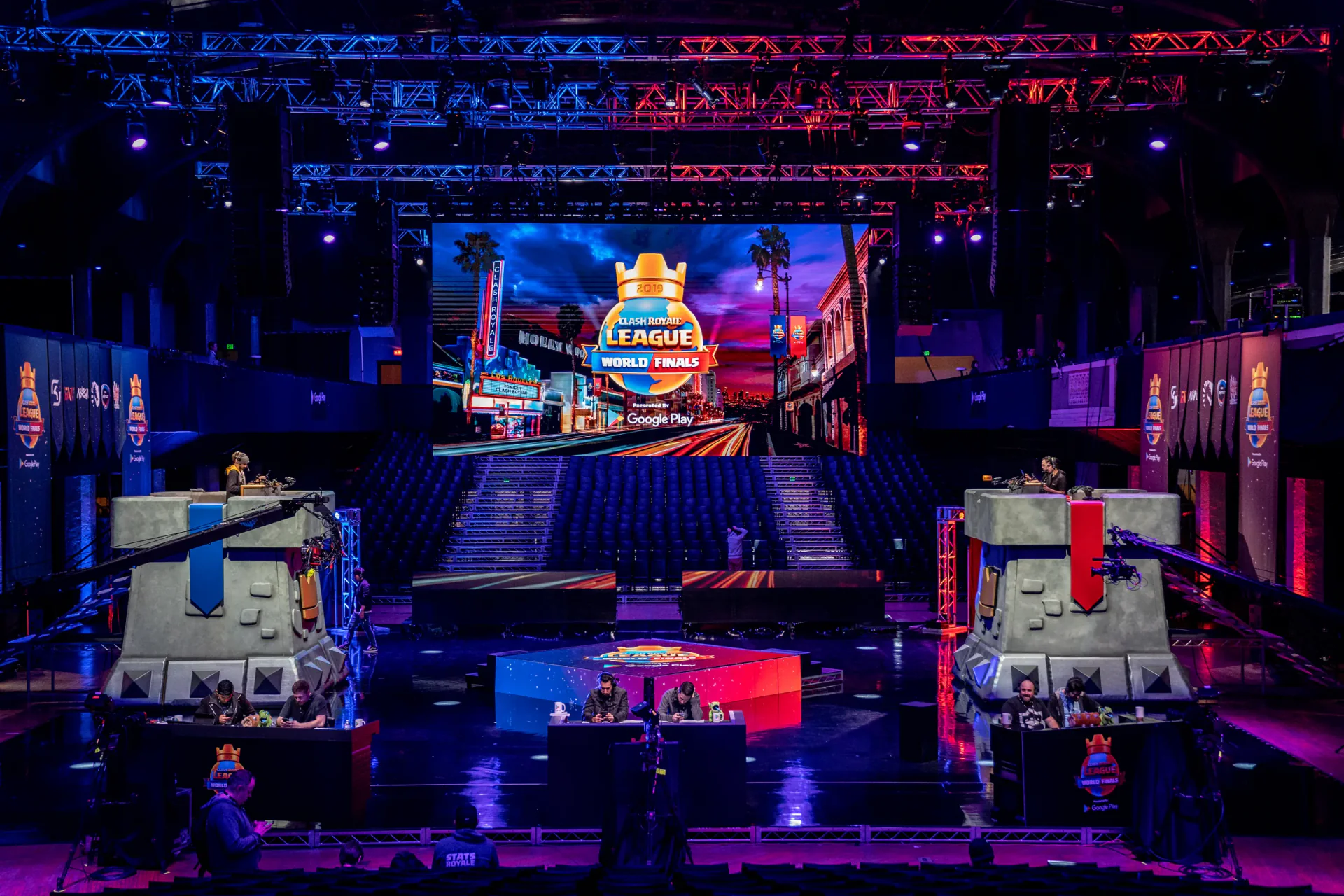
Six teams had earned their place at the World Finals at Los Angeles’s Shrine Auditorium. Fans had followed them all season. My challenge was to turn the game’s on-screen world into a physical setting that rewarded being there and felt familiar to fans watching the broadcast.
A / Audience
Give fans a reason to buy a ticket when they could watch online.
I wanted attending to offer something a stream couldn’t: stepping into the game’s world and sharing the final with people who cared about it as much as they did.
B / Business
Give the sponsor visibility with people who already cared about mobile gaming.
Google Play sponsored the championship and provided devices for the event. It was a fitting audience: people already invested in mobile gaming. I needed its support to be visible in the venue and on the broadcast, so I considered how the design would look in the room and on camera.
C / Culture
Give a world championship a Hollywood welcome.
A world championship brings teams from different places together in one city. For this final in Los Angeles, I drew on Hollywood’s culture of stardom to celebrate their arrival. Details like each team’s Walk of Fame star gave the competitors their moment in the spotlight, while keeping Clash Royale at the heart of the event.
The game became our set.
The arena, the battlefield players see on their phones, gave me the layout for the physical set.
Brand guidelines didn’t allow the game’s characters to be shown interacting with real life, so I worked with its arena and towers. Players entered as if stepping into a match, with fans surrounding the battle. That same world carried through the camera views, team flags, signage, and event passes.
Every team got its own Walk of Fame star.
The stars sat near the entrance, inspired by Hollywood’s sidewalk tributes to famous performers. Fans passed their team’s name on the way in.
Clash Royale led. Hollywood showed up in the details.
The signage had no owner. I took on the design.
I was putting together the operations manual, a shared guide to help the crew run the event. As I gathered the floor plans, event passes, hotel information, and event schedule, I noticed something missing: the directional signs hadn’t been designed.
Production and marketing each thought the other was handling it. I took on the signage design and added it to the manual, so the crew could find it alongside the rest of the event information.